An anti-colonial statement is Trump’s legitimization for unilateral military power

January 7, 2026

An anti-colonial statement is Trump’s legitimization for unilateral military power.


As I am passionate about factual information, history and see it as one of my tasks to inform SMEs in Spanish America about our (European) point of view regarding recent developments in the South American region, in the Dutch Financieele Dagblad a nice history lesson from historian Eline van Ommen, associate professor of International History at the University of Leeds in the United Kingdom. She argues that the gross and illegal U.S. violation of Venezuela's sovereignty and arrest of Maduro is unprecedented — even in the history of U.S. interventions in Latin America.


  • The previous intervention in the region was in 1989, when the United States invaded Panama, resulting in hundreds of civilian deaths.
  • The Monroe Doctrine of 1823, when the United States had been in existence for less than 50 years, was a declaration of solidarity, a political speech in which the fifth U.S. President James Monroe called for cooperation between like-minded and sovereign American republics – including Venezuela, which in 1821 became definitively independent from Spain – to keep European monarchies with colonial ambitions at bay. An anti-colonial statement that focused on European colonial interference in the Western Hemisphere being unacceptable. At that time, there were many more powerful European powers.
  • In 2026 , however, Trump is using the Monroe Doctrine as a unilateral American declaration of power. Latin America is said to be the 'backyard' of the US, in which the rest of the world has no business interfering. It is Trump's legitimization for unilateral military intervention.


More on this: https://www.politico.eu/article/donald-trump-western-hemisphere-americas-tariffs-panama-canal/?utm_source=RSS_Feed&utm_medium=RSS&utm_campaign=RSS_Syndication

  • In 1904,  the transformation of the Monroe Doctrine into an explicit instrument of power began. President Theodore Roosevelt then added the Roosevelt Corollary, giving the U.S. the right to intervene in Latin American countries that were economically or politically "unstable." During the last century, this 'right' was regularly used – the US intervened dozens of times in the region, sometimes openly militarily, but often through covert operations or political pressure.


While the U.S. has certainly tried to exert influence in South America in the past, this has always been in collaboration with local elites and military regimes, such as Pinochet in Chile and the Argentine junta. In official statements, American interests were invariably denied.


Imperialism


In Venezuela it is different. References to the Monroe Doctrine or to the Roosevelt Corollary conceal the fact that the kidnapping of Nicolás Maduro and Trump's claim that the US is now "running" Venezuela are completely unprecedented: 


This is the first time that the US has intervened militarily in a South American country.


Previous interventions took place in the Caribbean or in Central America. It is also unclear how the US could govern the country remotely, and what the local consequences will be.


The Venezuelans think they have been liberated and have hope for a better future. However, they are cut off from information and have been for years. How can they properly analyze what happens when it is already a full-time job for people with access to information? According to the BBC, armed police are currently patrolling the streets of Caracas. Many Maduro supporters are still in power. Intimidation and fear are unchanged.


Sources:

in Dutch: https://fd.nl/opinie/1582765/ingrijpen-in-venezuela-ondermijnt-trumps-macht

Engels:  https://www.bbc.com/news/live/cwy1x9vwn3dt

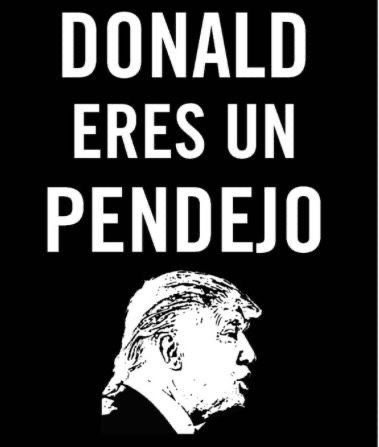
About the Donald Eres un pendejo campaign: https://www.theguardian.com/us-news/2016/oct/18/mexico-brands-advertising-donald-trump

What Venezuelans should know is that Trump is openly speculating about Venezuela's oil reserves and no U.S.-backed opposition leader has come to power. 


This intervention clearly breaks with the old pattern of regional cooperation and subtle diplomacy, in which Washington places itself above the entire region.


No understanding of power


Eline van Ommen concludes that in addition to poor historical knowledge, Trump's approach is also a fundamental misconception about what power means in international politics. Power – certainly in the longer term – is not only about military capacity, but rather about the ability to build alliances, promote norms and values and exert influence through financial incentives, such as development aid. 


The result will be more anti-Americanism and the further isolation of the US in the Western Hemisphere. Latin American governments that value national sovereignty will coordinate their foreign policies more, especially in international forums such as the United Nations and the Organization of American States.


In the past, Latin American states have often responded collectively and forcefully to unilateral American actions in the region. For example, Ronald Reagan's aggressive foreign policy in Central America in the 1980s led Mexico, Colombia, Panama and Venezuela to cooperate in the Contadora process to promote peace in the region – against the wishes of the US, and, with European support.

January 7, 2026
Una declaración anticolonial es la legitimación de Trump para el poder militar unilateral. Como me apasiona la información factual, la historia y lo veo como una de mis tareas para informar a las PYMES en Hispanoamérica sobre nuestro punto de vista (europeo) con respecto a los desarrollos recientes en la región sudamericana, en el periódico holandés The Financieele Dagblad una buena lección de historia de la historiadora Eline van Ommen, profesora asociada de Historia Internacional en la Universidad de Leeds en el Reino Unido . Ella argumenta que la grave e ilegal violación estadounidense de la soberanía de Venezuela y el arresto de Maduro no tiene precedentes, incluso en la historia de las intervenciones estadounidenses en América Latina. La intervención anterior en la región fue en 1989 , cuando Estados Unidos invadió Panamá, lo que provocó cientos de muertes de civiles. La Doctrina Monroe de 1823 , cuando los Estados Unidos habían existido por menos de 50 años, fue una declaración de solidaridad, un discurso político en el que el quinto presidente estadounidense James Monroe pidió cooperación entre repúblicas estadounidenses soberanas y de ideas afines, incluida Venezuela, que en 1821 se independizó definitivamente de España, para mantener a raya a las monarquías europeas con ambiciones coloniales. Una declaración anticolonial que se centró en la interferencia colonial europea inaceptable en el hemisferio occidental. En ese momento, había muchas más poderosas potencias europeas. Sin embargo, en 2026 , Trump está utilizando la Doctrina Monroe como una declaración de poder estadounidense unilateral . Se dice que América Latina es el "patio trasero" de los Estados Unidos, en el que el resto del mundo no tiene negocios que interferir. Es la legitimación de Trump para la intervención militar unilateral. Leer más: https://www.politico.eu/article/donald-trump-western-hemisphere-americas-tariffs-panama-canal/?utm_source=RSS_Feed&utm_medium=RSS&utm_campaign=RSS_Syndication
January 5, 2026
Your website is yours. As I look back on the projects I worked on for SMEs in Spanish America the last couple of months, there are a few subjects that all projects have in common across countries and which I will further dive into at a later stage. One subject I want to start with is the fact that companies heavily rely on social media and messaging apps for client and sales communication and why they should change this. I have explained the importance of creating (or improving) a website, being a channel that a company owns, fully deciding its design and content. The caveat is to be aware to store your website with a national cloud providor, due to the North American Cloud Act. What is the Cloud Act? It is a US federal law of 2018 (Clarifying Lawful Overseas Use of Data Act) that forces US technology companies to deliver data from their customers, regardless of where they are stored (including in data centres in Spanish America or Europe) if requested by US court order. The law also applies to European (and Latin American) organisations that use North American cloud services (such as Microsoft, Google, Amazon), allowing data in Europe (and Latin America) to be accessible to US authorities. What The Netherlands and Europe are doing, among other things, is creating awareness for this risk: Research has been done on the degree of dependence, and there is more awareness among governments and companies.
January 5, 2026
Su sitio web es suyo. Al mirar hacia atrás en los proyectos en los que trabajé para las PYMES en Hispano América en los últimos meses, hay algunos temas que todos los proyectos tienen en común entre países y en los que profundizaré en una etapa posterior. Un tema con el que quiero comenzar es el hecho de que las empresas dependen en gran medida de las redes sociales y las aplicaciones de mensajería para la comunicación con el cliente y las ventas y por qué deberían cambiar esto. He explicado la importancia de crear (o mejorar) un sitio web, siendo un canal que una empresa posee, decidiendo completamente su diseño y contenido. La advertencia es tener en cuenta que debe almacenar su sitio web con un proveedor nacional de nube, debido a la Ley de Nube de América del Norte. ¿Qué es la Ley de la Nube? Es una ley federal de los Estados Unidos de 2018 (Aclarificación de la Ley de Uso Legal de Datos en el Extranjero) que obliga a las empresas tecnológicas de EE. UU. a entregar datos de sus clientes, independientemente de dónde se almacenen (incluso en centros de datos en Hispano América o Europa) si así lo solicita una orden judicial de los Estados Unidos. La ley también se aplica a las organizaciones europeas (y latinoamericanas) que utilizan servicios en la nube de América del Norte (como Microsoft, Google, Amazon), lo que permite que los datos en Europa (y América Latina) sean accesibles para las autoridades estadounidenses. Lo que los Países Bajos y Europa están haciendo, entre otras cosas, es crear conciencia sobre este riesgo: se ha investigado sobre el grado de dependencia, y hay más conciencia entre los gobiernos y las empresas.
December 31, 2025
El Proyecto. Profesionalización de la función de marketing de un crematorio para mascotas en el eje cafetero de Colombia
December 22, 2025
The Project. Profesionalising the Marketing function of a pet crematorium in the coffee region of Colombia
October 16, 2025
The Project. Supporting a Bolivian business in processing and selling natural Bolivian cereals to win a new client group. Bolivia Natural approached PUM to help them improve their market position and increase sales. As this is a remote project, we focused on the most pressing element of their more extensive briefing, which is to help them with tapping into a new market opportunity. Due to the economic challenges Bolivia faces, spending power of the population has reduced, import prices of quality oat have risen to sky high levels and as a result, sales prices have risen quite substantially as well. The more affluent population can more or less absorb these price increases, there is a loyal clientele, but overall sales are impacted negatively for many entrepreneurs and overall there is scarcity of food and other imported products. Adapting to these circumstances is a must and innovation critical. To make up for declining sales of the company's more upmarket product offering, Bolivia Natural needs to innovate and bring a product to market for people with less spending power. As this project is still ongoing, I will update once appropriate.
October 11, 2025
The Project. A Peruvian family-owned chicken restaurant in need of marketing advice